A VA home loan with 0 down is not a promotion, a first-time-buyer program, or a rate you have to shop for. It is the standard structure of the benefit, and it works because the federal government stands behind part of the loan so the lender does not need your cash as a cushion.
Understanding the mechanism matters, because it explains both what zero down gets you and what it does not. Here is how a $0 down VA loan actually works, what you still bring to closing, and when putting money down is the better move anyway.
Why Lenders Accept Zero Down on a VA Loan
On a conventional loan, your down payment is the lender's protection. If you stop paying and the home sells for less than the balance, the equity you put in absorbs the loss first. That is why conventional lenders charge private mortgage insurance, usually called PMI, when you put down less than 20 percent. Someone has to cover that risk, and below 20 percent it is you, monthly.
A VA loan replaces your down payment with a government guaranty. The Department of Veterans Affairs backs a portion of the loan, so the lender has protection without needing your cash and without needing a monthly insurance premium.
That single substitution produces the three headline benefits:
- No down payment required for qualified borrowers
- No monthly mortgage insurance, at any loan-to-value
- Competitive interest rates, because the loan carries less risk for the lender
The absence of PMI is often worth more over time than the absence of a down payment. On a $350,000 conventional loan with a low down payment, mortgage insurance can run a few hundred dollars a month until you reach enough equity to drop it. A VA borrower never pays it.
Entitlement Is What Makes It Work
Entitlement is the dollar amount of the guaranty the VA will put behind your loan. It is the engine under the whole benefit, and it is why the answer to "how much can I borrow with nothing down" depends on your history rather than a single national number.
If you have full entitlement — you have never used the benefit, or you used it and had entitlement restored — there is no VA-imposed cap on the loan amount you can get with zero down. The limit is what a lender will approve based on your income, credit, and residual income.
If you have remaining entitlement, because you have an active VA loan or one that was not restored, county loan limits come back into play. Per the Department of Veterans Affairs, VA loan limits match the Federal Housing Finance Agency conforming limits. The FHFA set the 2026 baseline conforming limit at $832,750 for one-unit properties, with a ceiling of $1,249,125 in high-cost areas, effective for loans closed on or after January 1, 2026. Remaining entitlement is 25 percent of the county limit reduced by the entitlement you have already used and not restored.
Our guide to how VA loan entitlement works walks through the arithmetic, and 2026 VA loan limits explained covers the county figures.
What You Still Pay With Zero Down
This is where "zero down" gets oversold, and where military buyers get caught short at the closing table.
Zero down means no down payment. It does not mean no money.
You will still be responsible for:
- Closing costs. Origination, title, recording, and lender fees. On a purchase loan, the VA is explicit that you can finance only the funding fee into the loan amount. Everything else is paid at closing.
- Prepaid items. The first year of homeowners insurance and an escrow cushion for property taxes.
- Earnest money. Held in escrow when your offer is accepted, then credited back at closing.
- The home inspection. Separate from, and not replaced by, the VA appraisal.
- The VA funding fee, unless you are exempt.
Our guide to VA loan closing costs breaks down realistic dollar figures.
There is a lever worth using. The VA allows sellers and builders to offer credits toward buyer closing costs, and while it does not limit credits generally, it caps seller concessions at 4 percent of the home's reasonable value. Negotiating those credits is the most direct way to bring your cash-to-close near zero, and it is covered in using seller concessions to lower your closing costs.
The Funding Fee, Briefly
The VA funding fee is the one-time charge that keeps the program running without monthly mortgage insurance. It scales with your down payment and whether you have used the benefit before.
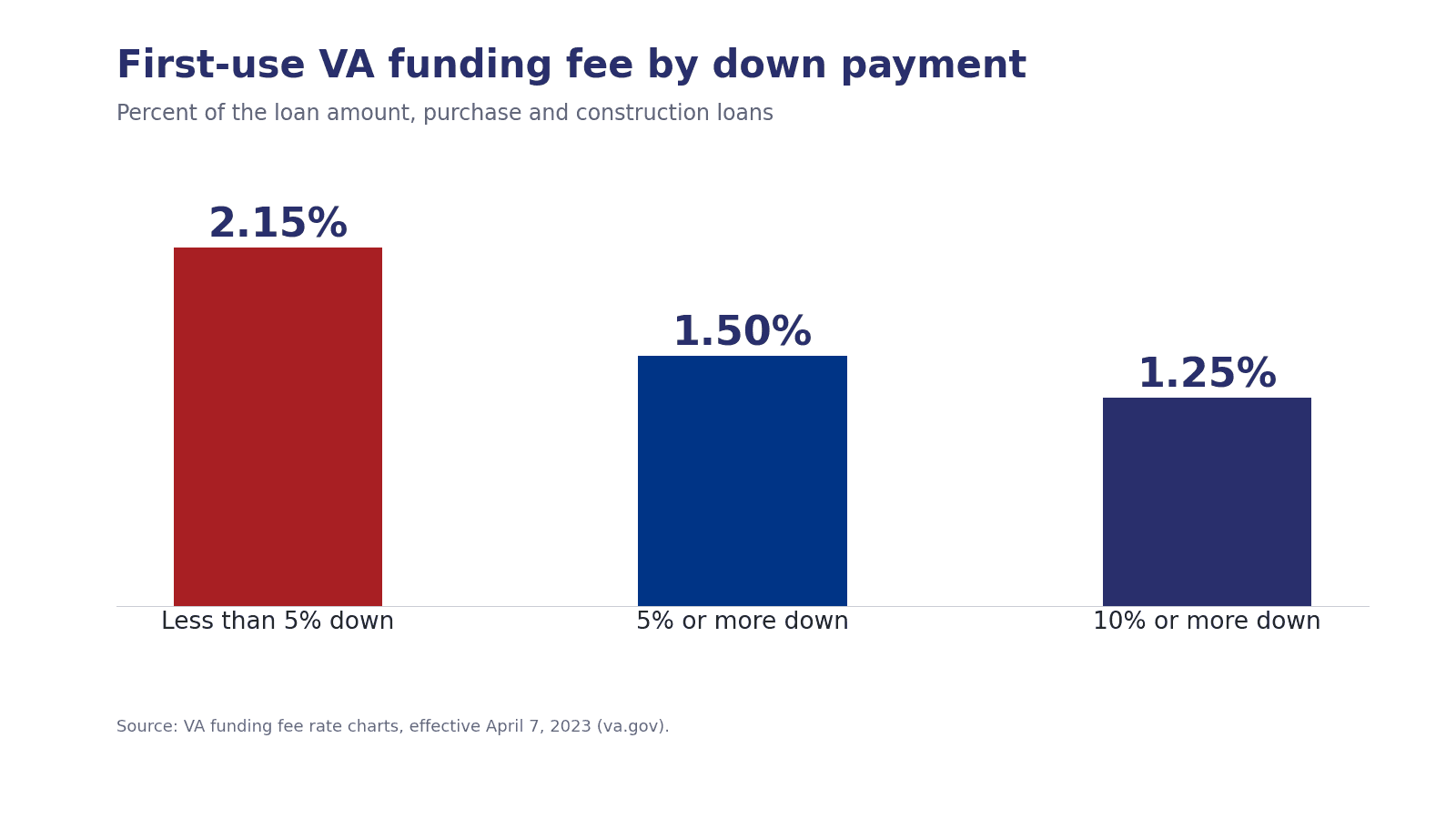
For a first-use purchase loan with less than 5 percent down, the fee is 2.15 percent of the loan amount, per the VA funding fee rate charts effective April 7, 2023. Put 5 percent down and it drops to 1.5 percent. Put 10 percent down and it drops to 1.25 percent. A subsequent use with less than 5 percent down is 3.3 percent.